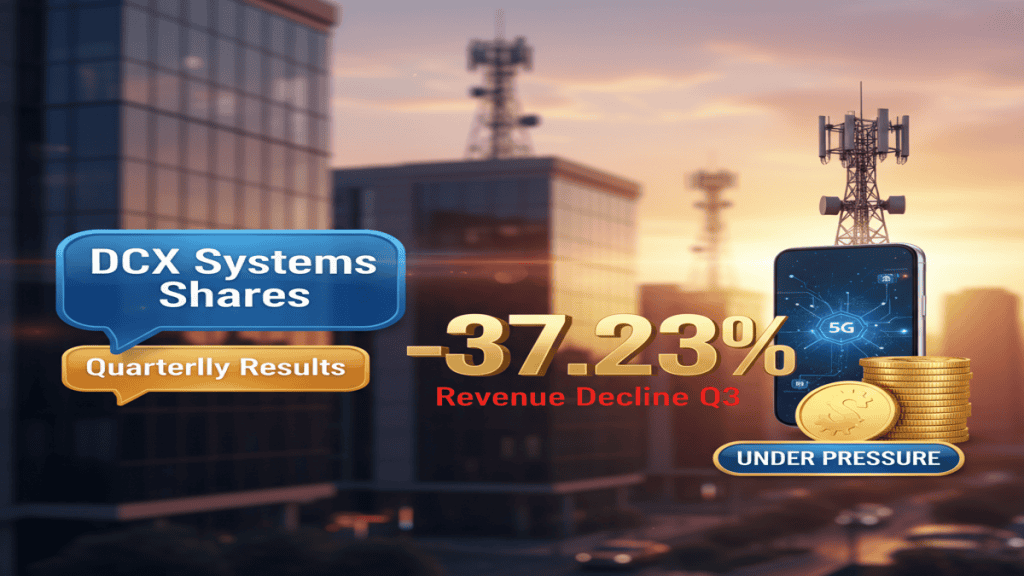


DCX Systems shares tumble after Q3 revenue drops 37.23% QoQ
What Happened
DCX Systems Limited is facing two contrasting market developments. The company’s results for the third quarter of FY26 revealed a significant operational setback, with revenue from operations declining 37.23% sequentially to ₹121.06 crore from ₹192.85 crore in the previous quarter. This top-line pressure led to a net loss of ₹2.43 crore for the quarter ended 31 December 2025.
In a forward-looking development, however, the company was included in a ‘Stocks to Watch’ list on 6 March 2026. This signals a potential shift in market focus from the weak quarterly performance towards the possibility of significant future business. For a key supplier in the defence and aerospace sector, this often implies anticipation of large-scale order inflows or major project announcements, which are pivotal for long-term growth.
This juxtaposition of poor recent financials against positive future expectations has created a complex narrative for the stock. Investors are weighing the tangible results of a challenging quarter against the prospect of a strengthened order book, a critical value driver in the capital-intensive defence industry.

Why This Matters
Scale of Development:
The inclusion on a watch list is significant when viewed against the company’s financial scale. With a market capitalisation of ₹2,219.93 crore, any substantial new contract would be material. For context, the company’s total revenue for the financial year ended 31 March 2025 was ₹1,083.67 crore. A large order could represent a considerable percentage of this annual figure, providing much-needed revenue visibility. This is particularly crucial following the latest quarterly revenue of just ₹121.06 crore for Q3 FY26, which underscores the project-dependent nature of its business. The annual net profit for the year ended 31 March 2025 stood at ₹38.88 crore, a figure that future orders would be expected to bolster.
Strategic Significance:
Securing new, large-scale orders is paramount for DCX Systems to reverse its recent negative performance. The company reported a negative operating margin of -0.81% for the year ended 31 March 2025, indicating that operational profitability is under pressure. A robust pipeline of high-margin contracts would directly address this. The company’s balance sheet appears well-positioned to take on new projects, with a Debt-to-Equity ratio of 0.00 as of March 2025. This strong capital structure provides the flexibility to fund working capital requirements for new orders without significantly increasing financial risk.
Financial Performance Context
Valuation Metrics (Current Market Data):
* Market Capitalisation: ₹2,219.93 crore
* P/E Ratio: 167.48
* Price-to-Book Ratio: 1.53
* EV/EBITDA: 125.32
Annual Operational Performance (For the Year Ended 31 March 2025):
* Total Revenue: ₹1,083.67 crore, reflecting a YoY decline of 39.5%
* Net Profit: ₹38.88 crore
* Net Profit Margin: 3.59%
* Operating Margin: -0.81%
Balance Sheet Strength (As of 31 March 2025):
* Total Debt: ₹3.75 crore
* Total Equity: ₹1,375.23 crore
* Debt-to-Equity Ratio: 0.00
* Current Ratio: 2.96
* Cash & Equivalents: ₹193.83 crore
Cash Flow Analysis (For the Year Ended 31 March 2025):
* Operating Cash Flow: ₹495.90 crore
* Free Cash Flow: ₹195.89 crore
* Capital Expenditure: ₹300.02 crore
Quarterly Performance Trend:
* Q3 FY26 (ended 31 December 2025): Revenue ₹121.06 crore, Net Loss ₹2.43 crore
* Q2 FY26 (ended 30 September 2025): Revenue ₹192.85 crore, Net Loss ₹9.04 crore
* Quarter-over-Quarter Change: Revenue -37.23%, Net Loss narrowed by 73.16%
How Today’s News Impacts These Metrics:
The anticipation of new orders is the primary factor supporting the company’s high valuation multiples, such as a P/E ratio of 167.48. The market appears to be pricing in a significant turnaround. If they materialise, new orders would directly combat the negative revenue growth trend seen in Q3 FY26 and the -39.5% YoY decline for FY25. Furthermore, new projects are essential to lift the operating margin from its negative territory of -0.81% (for FY25) and improve profitability.
Market Sentiment & Impact Analysis
Overall Market Sentiment:
Market sentiment for DCX Systems appears cautiously optimistic, with market participants looking past the weak Q3 FY26 results to focus on future potential. This outlook is supported by the prospect of improved earnings visibility from new contracts, a favourable macro environment driven by government policy in the defence sector, and sustained investor interest in defence indigenisation themes.
Stock-Specific Impact:
The news reinforces the market’s forward-looking narrative, suggesting potential for significant future order inflows critical for improving earnings visibility. This is particularly relevant given the company’s recent 37.23% QoQ revenue decline and quarterly losses. The inclusion on a watch list may attract increased investor attention and trading volumes. For a company with promoter holdings at 54.66% and institutional holdings at 4.02%, positive attention could broaden the investor base.
Sector & Broader Market Implications:
While this development has a minimal direct impact on the broader Aerospace & Defense sector, it aligns with the prevailing positive sentiment for the industry, which is underpinned by government initiatives promoting defence self-reliance. As a small-cap stock with a market cap of ₹2,219.93 crore, this news is unlikely to have a material impact on broader market indices.
Risk Factors to Monitor:
Two primary risks have been identified. The first is Execution Risk, as positive sentiment is based on anticipation. A failure to secure or significant delays in expected large orders could reverse sentiment. The second is Valuation Risk. The stock’s high trailing P/E ratio of 167.48 is predicated on a significant operational turnaround. If anticipated performance improvements do not meet expectations, the current valuation may be difficult to sustain, especially with the stock trading at ₹199.3, well below its 52-week high of ₹363.8.
What Investors Are Watching Next
Immediate Catalysts (Next 1-3 months):
* Order Announcements: Any formal disclosure to the exchanges regarding new contract wins.
* Q4 FY26 Results: The upcoming quarterly earnings will be scrutinised for signs of a revenue recovery and improved profitability.
* Management Commentary: Guidance provided during the next earnings call regarding the order pipeline and margin outlook.
Medium-term Catalysts (Next 3-12 months):
* Revenue Recognition: The timeline for revenue booking from any new large-scale projects.
* Margin Improvement: Evidence of an improving operating margin from the -0.81% reported for FY25.
* Working Capital Management: Efficient management of the working capital cycle as the company potentially scales up.
Key Monitoring Metrics:
Investors will be closely tracking:

- Execution progress on any newly announced contracts.
- Quarter-over-quarter revenue growth trends to see a reversal from the -37.23% decline in Q3 FY26.
- Margin evolution compared to the net profit margin of 3.59% for FY25.
- Cash flow generation, particularly free cash flow, against the baseline of ₹195.89 crore for FY25.
FAQs
1. What is the financial impact of this development?
The immediate financial impact is on market sentiment. The underlying performance was weak, with a 37.23% sequential revenue drop in Q3 FY26. However, the anticipation of new orders, if they materialise, could significantly boost future revenue above the ₹1,083.67 crore reported for the year ended 31 March 2025.
2. How does this compare to the company’s existing business scale?
The company’s current scale includes annual revenue of ₹1,083.67 crore (for FY25) and a market capitalisation of ₹2,219.93 crore. A single large defence contract would be highly material and could represent a significant portion of its annual turnover.
3. What are the execution risks or challenges?
The primary risk is that anticipated orders do not materialise. If they do, challenges include managing supply chains and adhering to delivery timelines. The company’s Current Ratio of 2.96 (as of March 2025) suggests it has adequate liquidity to manage working capital needs for new projects.
4. How will this affect the company’s financial ratios?
If large orders are secured, it could positively impact several ratios. Revenue growth would improve, potentially reversing the -39.5% YoY decline seen in FY25. Higher capacity utilisation could improve the operating margin from -0.81% (for FY25). Stronger earnings would help rationalise the high P/E ratio of 167.48.
5. What is the sector context and competitive positioning?
DCX Systems operates in the Aerospace & Defense sector, a key focus area for the government’s ‘Make in India’ initiative. As a manufacturer of electronic systems and cable harnesses, it is a supplier in the domestic defence ecosystem.
6. What are the regulatory or compliance implications?
While being on a ‘watch list’ is not a formal regulatory event, any material order win would require the company to make a prompt disclosure to stock exchanges under SEBI’s Listing Obligations and Disclosure Requirements (LODR) Regulations.
7. What should investors monitor going forward?
Investors should monitor:
* Revenue Growth: Any improvement from the ₹121.06 crore reported in Q3 FY26.
* Margin Trends: Progress towards improving the negative operating margin of -0.81% (for FY25).
* Debt Levels: Maintenance of the low debt position, which stood at ₹3.75 crore as of March 2025.
* Order Book: Official announcements of new contract wins and the total size of the order book.